My name´s Hannah, not Anna
«My name´s Bond. James Bond». Ian Fleming, British writer
↑↓
Present tense
The form of the verb that is used to show what happens or exists now:
↓
-Present tense Verb Be. Positive form → full form and contraction (we use contractions
in conversation and in informal writing, e.g. an email to a friend)
I → am. For example: I´m Mae (My name is Mae). I´m sad. I´m here, in class.
He, She, It → is
You, We, They → are
-Present tense Verb Be, negative form → full form and contraction
Be es uno de los pocos verbos que en inglés puede negarse a sí mismo.
I → am not / ´m not
He, She, It → is not / isn´t
You, We, They → are not / aren´t
-Present tense Verb Be Interrogative form → question form and positive (don´t use
contractions in positive short answers) or negative short answer
Am → I …? / Yes, I am / No, I´m not
Is → he, she, it … ? Yes, he, she, it is / No, he, she, it isn´t
Are → you, we, they… ? Yes, you, we, they are / No, you, we, they aren´t
You can also contract are not and is not like this: You´re not Italian / She´s not Spanish
e.g. How old are you? I´m 36 years old
Con las W questions se puede abreviar: Where´s she from? / What´s her first name?
↑↓
Present Simple
We use the present simple to talk about:
- habits and routines. Things that habitually happen.
- things that are always or generally true
Spelling rules for the third person singular are the same for the plurals
-/s/Most verbs add -s: works
-/iz/Verbs ending in s, z, ch, sh, or x add -es: misses, watches, finishes
-Verbs ending in y (consonant + y), change to -ies
-/z/Exceptions: have – has / go – goes
Negative form → with an auxiliary Do /does
Interrogative form → we need an auxiliary to form questions: Do / does
ASI → auxiliary, subject, infinitive
QASI → question word, auxiliary, subject, infinitive
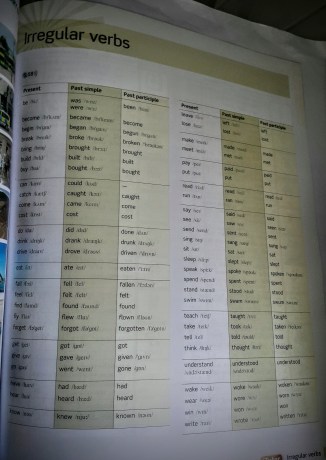
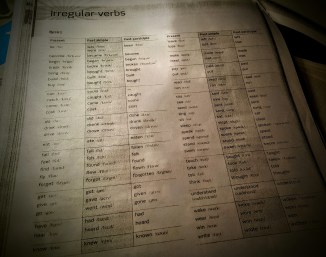
Irregular verbs
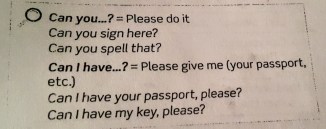
Can you…? Can / Can´t
-Can you introduce yourself?
-Can you spell the word?
We often use adverbs of frequency (always, usually, often, sometimes, rarely, never) and expressions of frequency (once / twice a week, on Friday, at the weekend, in the summer, every …) with the present simple to talk about how often we do something.
↑↓
Adverbs and expressions of frequency
We use adverbs of frequency to say how often you do something; they go: before all main verbs and → after verb be.
Use a positive verb with → never and hardly ever.
In negative sentences the adverb of frequency goes between the auxiliary and the verb.
↓
-Always
-Usually
-Often
-Sometimes
-Hardly ever
-Rarely
-Never
Expressions of frequency / How often do you ….?
They usually go to the end of the sentence or verb phrase →and sometimes goes at the biginning.
-once
-twice a week, a day etc.
-two or three times a night
-every day, time, week
-in the winter /summer …
↑↓
Imperatives
Use imperatives to give orders or instructions.
After 300 metres, turn right. Imperatives, let´s
(+) imperatives = verb infinitive
(-) imperatives = don´t (auxiliary) + verb
Turn right! /Don´t turn right!
Park here! / Don´t park here!
Add «please» to be polite: Open the door, please
We often use be + adjective in imperatives: Be quiet, Be careful etc.
Don´t use pronoun whith imperatives: Be quiet
–Let´s. Use Let´s + verb infinitive to make Suggestions.
Use Let´s not + verb to make negative suggestions: Let´s not wait
Let´s stop at that service station / Come on. Let´s go
Present simple passive / by + agent
Form
We form the present simple passive with the present simple of the verb to be (am / is / are) + past participle.
We use the present simple passive when we want to focus on a an action or the object of the action, rather than the person who is doing the action. The object of the active setence becomes the subject of the passive sentence.
by + agent
In an active setence, you know who did the action → Teachers teach Kung Fu in many countries.
In a passive sentence, we can say who did the action (the agent) using by → Kung Fu is taught by teachers in many countries.
We use by + agent when it is important to know who did the action → Kung Fu is taugh
↑↓
Present Perfect
-We use the present perfect when we talk or ask about things that have happened in the past, but when we don´t say when. To talk about an action that happened sometime in the past but we don´t know the exact time.
When we use the present perfect simple we often do not say when the action happened.
-We often use the present perfect with ever (= at any time in your life) and never (= at no time in your life).
-We also use the present perfect to talk about something that has recently happened or about an action that started in the past and is still true today.
We often use the present perfect simple with for and since. We use for to talk about the duration of a present situacion, for example, for 30 minutes, for two months. My sister has lived in London for six months.
We use since to show the starting point of a present situation, for example, since 2.00 pm, since Friday, since 2011. My sister has lived in London since September.
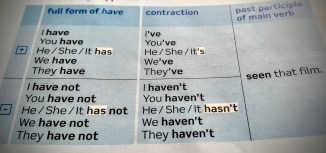
-To make the present perfect use have/has. We form the present perfect simple with the present simple of the verb to have plus the past participle.
We also use have/ has and haven´t / hasn´t to form short answers: Have you lived in Canada? Yes, I have.
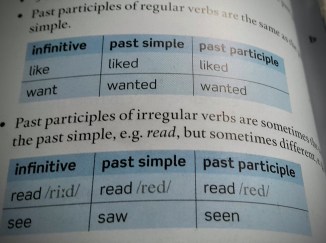
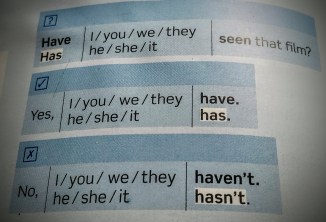
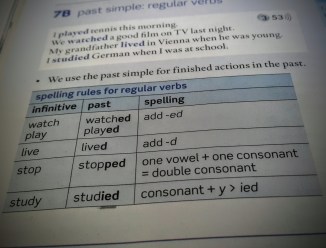
We add -ed to regular verbs to form the past participle: work → worked, walk → walked, play → played
The spelling rules for other regular verbs are the same as for the past simple tense.
Many verbs have irregular past participle:
buy → bought, do → done, find → found, see → seen, take → taken, teach → taught
The verb go has two past participles forms: been and gone.
I´ve been to work today (And now I´m back)
He´s gone to work today (He insn´t back yet)
Present Continuous
We form the present continuous with the present simple of verb to be plus +ing form the verb
Use
We use the present continuous to talk about:
- things happening now. eg. He´s watching the news on TV at the moment.
- things happening around now, but not necessarily at the moment. eg Vicky´s travelling to several African countries this year.
- current trends and changing situations. eg. Fewer people are buying cars this year.
Spelling rules
Notice the spelling rules for the -ing form:
- for most verbs, add – ing (walk → walking; play → playing; read → reading)
- for verbs ending in a consonant + vowel + consonant, double the last letter of the verb and add – ing (sit → sitting; run → running)
- for verbs ending in e, delete the final letter and add – ing (make → making; write → writing)
Verbs + -ing
We add – ing to the main verb. The spelling rules are the same as for the present continuous.
Use
We use the verb + -ing form:
- as the subject of the sentence. The -ing form is often a noun. eg. Eating a lot of fruit is important
- after a preposition. I´m very good at playing tennis.
- after verbs such as → like, love, enjoy, prefer, don´t like, hate, can´t stand, not mind as an object. eg. I love walking in the mountains.
↓↑
like + -ing / would like to
We use like + ing to talk about → a general feeling which is true now.
eg.
Richard likes skiing a lot.
Ella doesn´t like listening to rap music.
´d like to (= would like to)
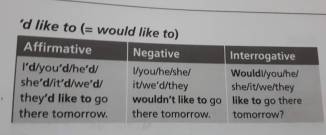
We use ´d like to to talk about a future ambition.
eg.
I´d like to visit Kenya next year.
She wouldn´t like to work in an office when she leaves school.
Would you like … ?
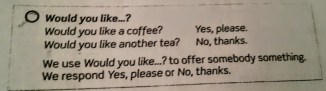
Modal verbs
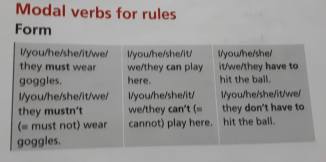
There are two important differences between Must and Can / Could and regular verbs in the present simple:
- There is no third person -s with modal verbs. eg. She must go. I can stay
- There is no auxiliary do whith modal verbs. eg. I mustn´t lose. He can´t play
-Can you introduce yourself? / Could you… ? -> for past interrogative
-Couldn´t -> for past negative
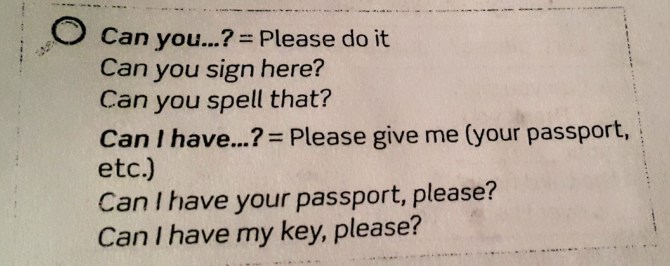
- Have / have to is a regular verb. eg. I have to go. He has to help. I don´t have to play. She doesn´t have to compete.
Use
We use different modal verbs to talk about rules.
- When something is necessary and an obligation, we use must, have to and mustn´t. eg. You must be home at eleven o´clock. You have to finish your homework tonight. He mustn´t leave the house.
- When something is allowed according to the rules, we use can. eg. Yes, you can go to tre cinema on Friday
- When something is not necessary (but allowed), we use don´t have to. eg. You don´t have to wear a suit at the meeting.
- When something is not allowed, we use mustn´t and can´t. eg. She mustn´t tell anybody. He can´t play football tomorrow.
Bibliography:
Life. Pre Intermediate. By John Hughes, Helen Stephenson and Paul Dummett.
English File. Elementary By Christina Latham Koening, Clive Oxenden, Paul Seligson /
Third Edition. Descargar