
Past tense, a form of a verb that shows the time of its action in relation to the time of speaking
Past Simple
Past simple of verb be: was / were
-We use past simple – > to talk about the past / telling a story. We use the past simple to talk about completed actions and events in the past. We use the past simple for finished actions in the past.
-The past simple is the same for all persons ( I, you, she, etc)
-We often use the past simple with a time phrase; with past time expressions, e.g. yesterday, last night, in 1945 etc.
eg : I was born in Hungary. I visited Paris in January. They didn´t see his new film last night
↑↓
Regular verbs
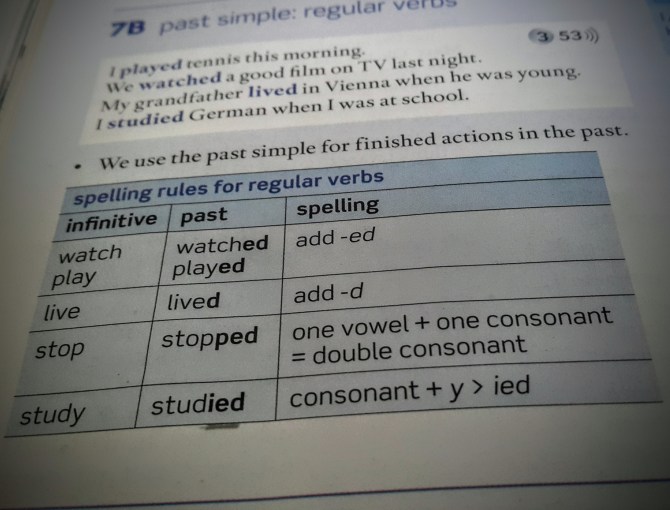
Spelling rules for regular verbs:
↑
-Regular verbs in the past afirmative end in -ed → e.g. worked, lived, played.
/d/, /t/ or id/
Notice the spelling rules for other regular verbs:
- for verbs ending in -e, we addv-d: eg. die → died
- for verbs ending in -y, we change the -y to i and add -ed: eg. try → tried; cry → cried; study → studied
- for verbs ending in vowel + consonant (not -w, -x, -y), we double the consonant: stop → stopped.
We use the auxiliary verb did/didn´t to form → negatives and questions. eg. Kirsten didn´t go on the adventure. Did you live in Peru?
↓
We also use did / didn´t to form short answers.
Did you live in Peru? Yes, I did.
Did Kirsten go on the adventure? No, she didn´t.
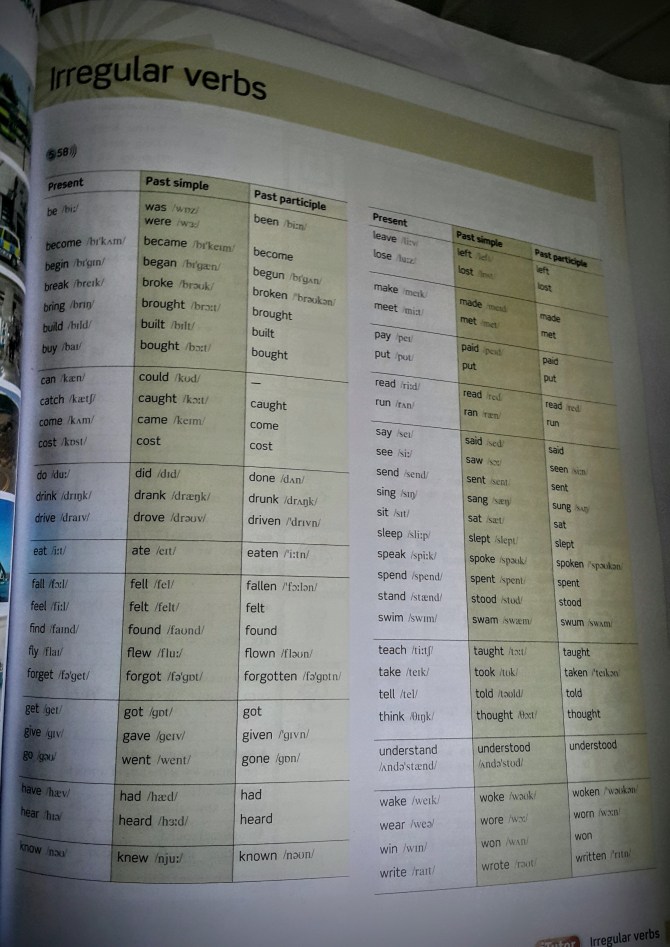
Irregular verbs
Some verbs have an irregular affirmative form in the past simple:
be → was / were; do → did; go → went; drive → drove; know → knew; take → took.
-Use the irregular past form → only in afirmative sentences: eg. I saw a film last night.
↑
-Use the infinitive after did/did´t for past simple interrogative and negative. Idid´t go last night.
Remember word order in questions = ASI or QUASI
Can you…? Can / Can´t → Past of can = Could
-Can you introduce yourself? / Could you… ? -> for past interrogative
–Couldn´t -> for past negative
Past Continuous
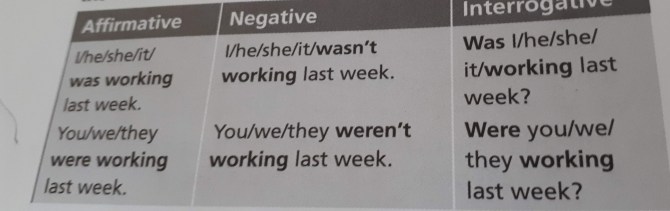
We form the past continuous with the past simple of the verb to be plus -ing form of the verb
Use
We use the past continuous to:
- describe actions and situations in progress at a particular time in the past. eg. Paul was watching TV. Katy was reading a book.
- talk about the background to a story. The sun was shining and the birds were singing
We often use the past continuous with the past simple to talk about two action that happened at the same time in the past. We can join the tenses with the words → when or while. eg. Tania was waiting at the station when the rest of the climbing team arrived. While the team were walking to the train, she ran to meet them.
Remember, we don´t usually use → stative verbs (e.g. be, like, believe, understand) in the continuous form.
↑↓
English. Writing / Composición
↓
Bibliography:
Life. Pre Intermediate. By John Hughes, Helen Stephenson and Paul Dummett.
English File. Elementary By Christina Latham Koening, Clive Oxenden, Paul Seligson /
Third Edition. Descargar


Pingback: English / Verbs | CELN - ¿Cuál es la noticia...?
Pingback: English / Inglés | CELN - ¿Cuál es la noticia...?